Skip to content
Obserya

Local on Windows · Developed by CoreWeb Studio

Local website audit software for technical SEO and AI readiness

Obserya audits a site on your own machine and links each finding to the affected page and the value measured there. The result is an action plan for both the client and the implementation team.

  • Analysis runs locallyNo cloud, no account
  • Findings carry evidenceAffected page and measured value
  • Results you can hand overClient report and technical exports
Technical SEO on the left, both scores in the centre, AI readiness on the right.Local OnlySQLite · localWindows desktop
  • Technical SEO7 core areas, each scored
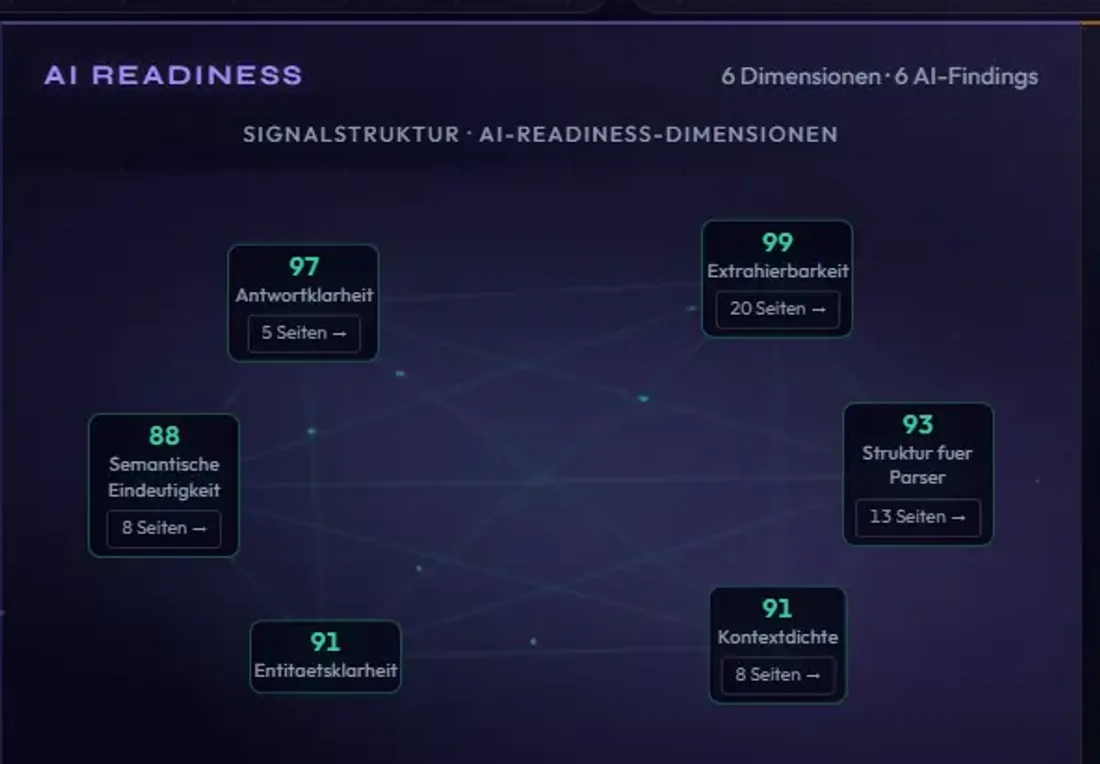
  • AI readiness6 dimensions as a signal map
  • FindingsSorted by severity

The application interface is currently in German. Screenshots on this page show it as it is.

What is Obserya?

Obserya is website audit software built by CoreWeb Studio for Windows. It crawls a site locally, scores technical SEO and AI readiness on two separate axes, and backs every finding with the affected page and the value measured there. From that it produces a prioritised action plan, a PDF client report and technical exports.

Why Obserya exists

The gap lies between the crawl result and the handover.

An audit score describes a state, but it assigns no responsibility. Which page is affected, and who tackles what first, is usually worked out by hand after the crawl. Obserya brings that step into the analysis.

  1. Overall score

    90/100 does not mean flawless

    The overall score summarises the site’s condition. Findings show which specific issues still need attention despite a strong score.

  2. Finding

    The finding names the problem and where it occurs

    It describes the concrete issue and leads to the affected URLs.

  3. Evidence

    Evidence makes the finding verifiable

    The measured values, the target and the page context show why the finding holds.

  4. Action

    Prioritised and ready to hand over

    Effort, owner and next step prepare the finding for implementation.

Obserya does not replace an enterprise crawler. It closes the gap between the crawl result and implementation, where signals turn into prioritised work packages.

How Obserya works

From a URL to an action plan you can hand over.

Each step carries the previous step’s data forward — so any finding traces back to its source.

  1. Local HTML crawl

    The site is captured on your own machine.

    Obserya fetches and parses the delivered HTML while following internal links. The result is a full page inventory with metadata, status codes and an internal link graph.

    • Crawl engine
    • Fetcher and parser
    • Internal link graph
  2. Page classification

    A legal notice is not judged like a service page.

    Every page is assigned a role. A missing meta description weighs differently on a utility page than on a service page.

    • Service pages
    • Content pages
    • Utility and legal pages
  3. Analysis layers

    Two axes, scored separately.

    Technical SEO and on-page signals on one side, AI readiness and GEO signals on the other — with no third number blending the two.

    • Indexability and linking
    • Metadata and page structure
    • Answer clarity and extractability
  4. Evidence-based findings

    Every finding carries its proof.

    A finding consists of the affected page, the issue and the value measured there. Where no reliable occurrence can be established, Obserya says so explicitly.

    • Affected URL
    • Measured value
    • Evidence quality
  5. Prioritisation

    Order comes from effort, impact and evidence.

    Findings that can be implemented directly stay separate from those that need verifying. Both get an owner and a first step.

    • Impact and effort
    • Owner
    • Verification flagged
  6. Reports and exports

    The client report and the technical exports come out of the same audit state.

    The client report explains the state without SEO vocabulary; the exports pass the same data to the implementation team.

    • PDF client report
    • Technical exports
    • Report generator

The workflow as a diagram

Select a step.

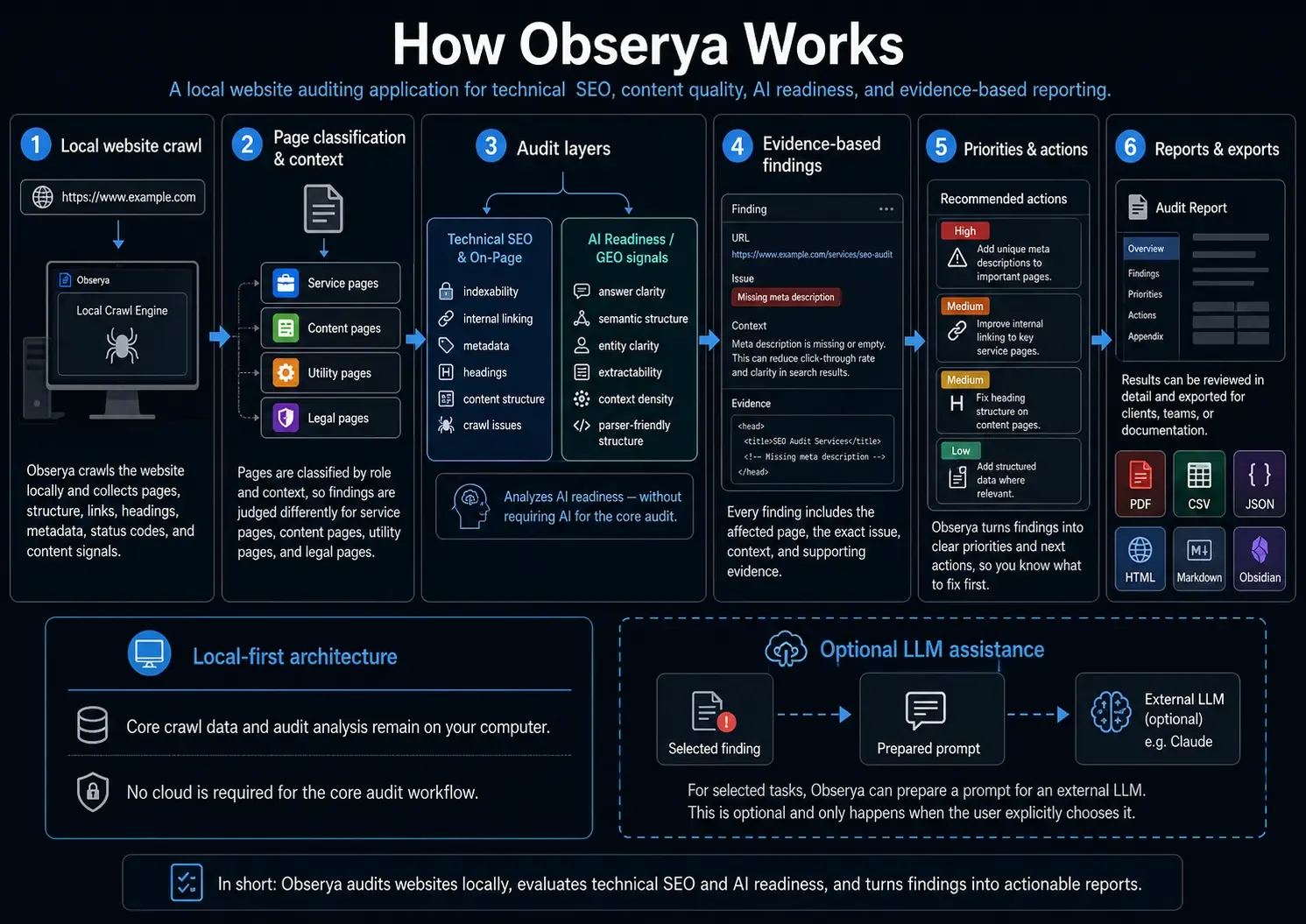
Workflow diagram “How Obserya Works” with six steps from the local crawl through to reports and exports.

Full workflow

How Obserya Works: six steps from the local crawl through to reports and exports, with the local-first architecture and optional LLM path below.

Select a step.

What Obserya checks

Two scoring axes that lead to different work.

Technical SEO describes the foundation for classic search; AI readiness describes how well the same page reads as an answer source.

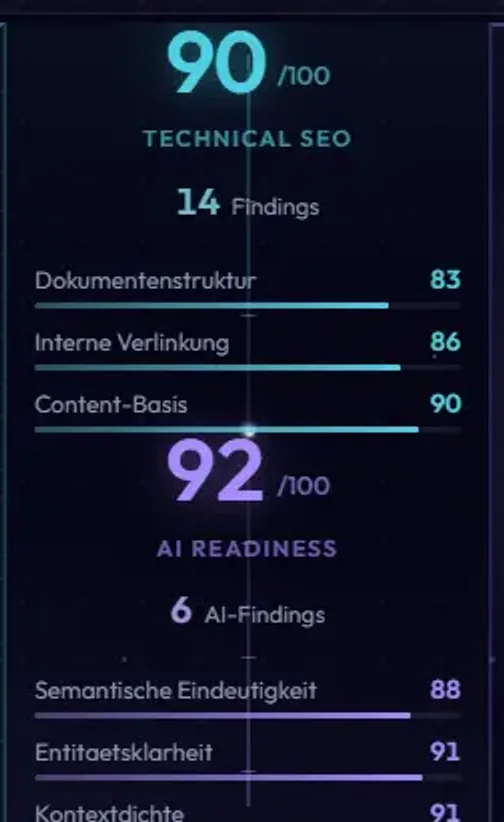
Score column of the dashboard with the technical SEO score and AI readiness score stacked separately.

Why there is no third score

A page can be technically sound and still be hard to use as an answer source. An average would hide that difference.

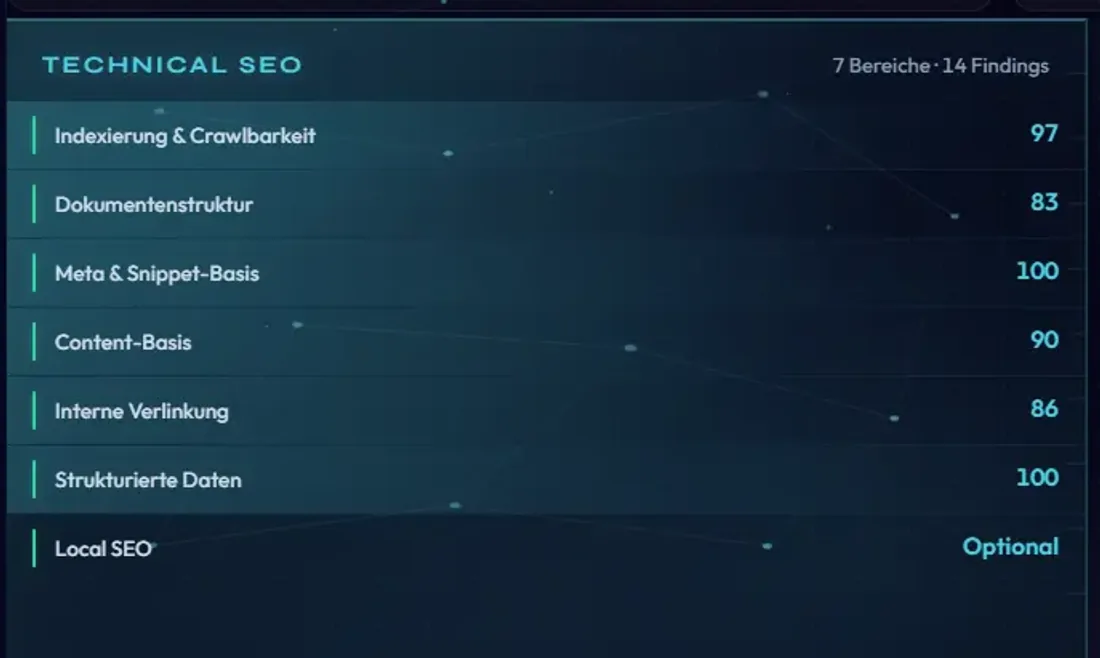
Technical SEO area of the dashboard with the seven core areas and Local SEO as an optional block.

Technical SEO

Visibility foundation for classic search

7 core areas
  1. Indexing and crawlabilityrobots.txt, sitemap, meta robots, redirect chains and loops, canonicals.
  2. Document structureHeading levels without gaps, real semantic regions.
  3. Meta and snippet basicsTitle and meta description: present, long enough, useful.
  4. Content basicsContent substance, near-empty pages, similarity between project pages.
  5. Internal linkingBroken targets, non-functional links, inbound links, orphan warnings.
  6. Structured dataExisting schemas, including schema that does not match the page type.
  7. Images and page elementsMissing alt text in content context, decorative images excluded.

Local SEOoptional

Local signals run as an optional block at project level; the standalone analysis area arrives with the beta cut.

AI readiness area of the dashboard with six dimensions shown as a connected signal map.

AI readiness

Usefulness as an answer source

6 dimensions
  1. Answer clarityDoes the key statement appear early enough to be quoted?
  2. ExtractabilityCan the core content be lifted out of the layout?
  3. Semantic clarityReal semantic regions, or only generic containers?
  4. Parser-friendly structureAre order, levels and section boundaries machine-readable?
  5. Entity clarityIs it clear which company and which service the page is about?
  6. Context densityDoes the page carry context of its own?

Findings and evidence

A finding tied to a page, with proof and a next step.

Six findings from a demo audit. The technical key appears the same way in the exports.

Select a finding

Finding types and actions match the application; quantities come from the demo audit.

Technical SEO · Internal linking

Empty or non-functional link

Links lead nowhere: an empty target, a bare hash, or a script call.

Affected
11 links on the page
Captured per occurrence
The link target and the anchor text as they appear on the page.
Action
Set a valid target, or mark the element up as a button.

Sufficiently evidencedAffects the score
The filtered list on the left, the selected finding on the right.

Evidence quality and urgency are two different things

A finding whose evidence is only partly conclusive is filed under “verify first” rather than in the immediate list.

Prioritisation and drilldowns

What comes first, and who picks it up.

Obserya ranks findings by impact, effort and evidence quality, and shows its working.

Score class

Where the measured value sits on the scale.

A project scoring 91 falls into the “Good” class.

Action status

Whether evidenced findings are still open.

That same project can still have confirmed actions outstanding.

Both appear separately in the report and are easily confused.

Feasibility classes

The labels come from the report and describe how directly a finding can be acted on — they are not deadlines.

  1. Low effort

    This week

    Well evidenced and actionable without further checks.

  2. More effort

    This month

    Clear in substance, heavier to implement.

  3. Check before acting

    Verify first

    Evidenced, but worth confirming manually once.

Score classes

0–60
Significant work needed
61–75
Needs improvement
76–85
Solid
86–95
Good
96–100
Very good

Bar width matches the value range: “Very good” covers five points, “Significant work needed” covers sixty-one.

From project to occurrence

  1. ProjectOverview

    Both scores, all areas and the overall status.

  2. AreaInternal linking

    One analysis area with its value and findings.

  3. Findingempty_or_nonfunctional_link

    The issue with its cause, action and affected pages.

  4. PageOccurrence

    The specific URL with the value measured there.

Every level stays navigable.

Findings strip from the project overview, each card showing severity, channel, technical key and the number of affected URLs.
Findings on legal and utility pages are marked as not affecting the score.

Local-first architecture

The audit runs on your machine.

Crawling, analysis, scoring and report generation all run on the device. The audit data sits in a database of its own there.

On your machine
  • Crawl
  • Analysis
  • Scoring
  • Findings and evidence
  • Report and export generation
  • Local database

The crawl of the target site needs network access.

Optional

Leaves the device only when triggered

  • External LLM (opt-in, per task)
  • The audit core stays on the device

    From page capture through to the finished report.

  • Audit data stays on the device

    Crawl and page data, findings, evidence and project settings.

  • No service in between

    The core workflow needs no account and no API key.

  • Sending data out is a decision

    Whether anything leaves is decided by the user, per task.

Where each step happens

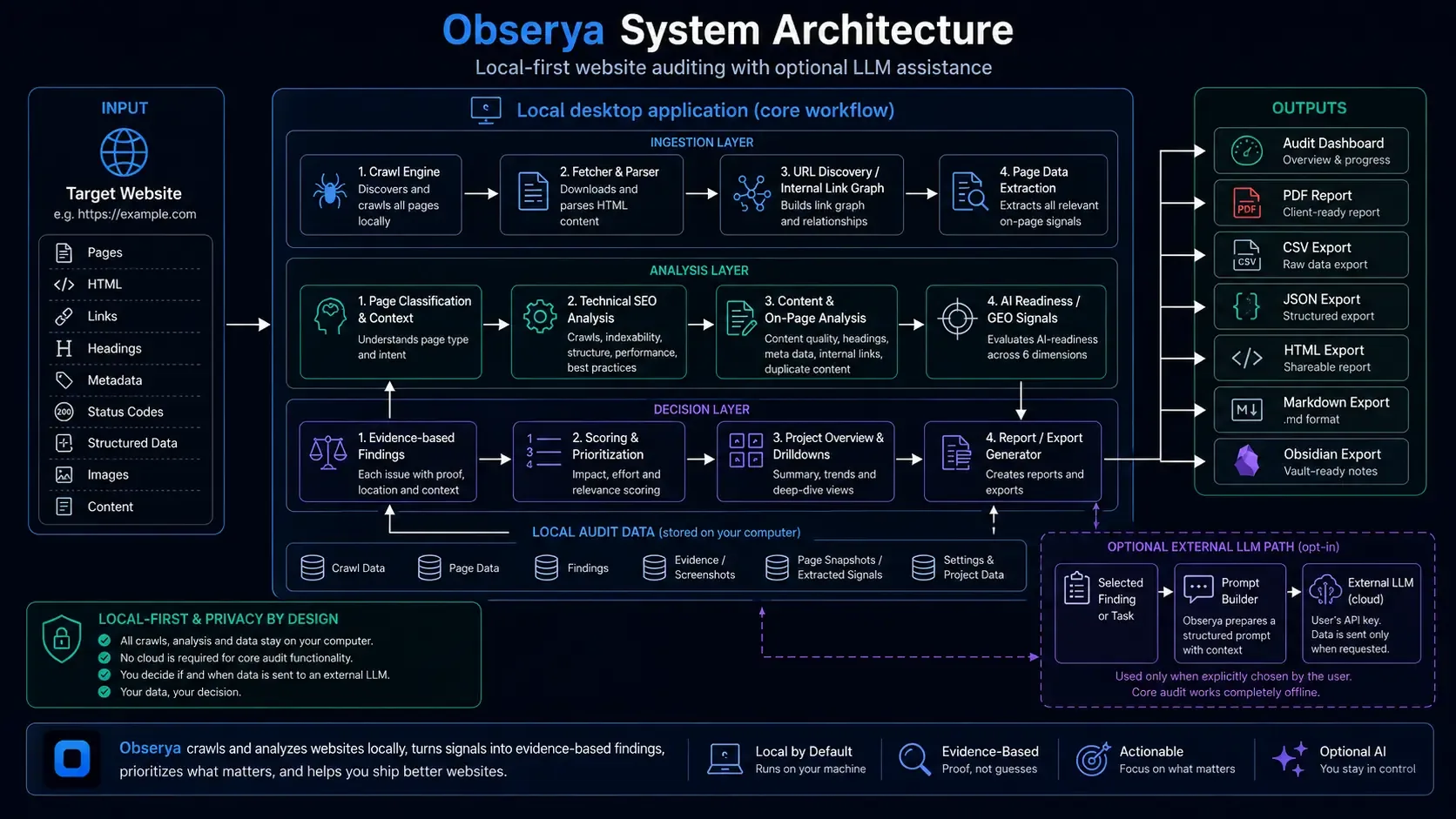
Everything inside the large block runs in the application. Only the dashed path at the bottom right leaves the device.

Architecture diagram “Obserya System Architecture” with input, the local desktop application, outputs and the optional LLM path.

Full view

Obserya System Architecture: input signals, the local application with its ingestion, analysis and decision layers, local audit data, outputs and the optional LLM path.

Select a section.

Optional LLM assistance

The audit core is local and rule-based.

Crawling, analysis, scoring and reports all work without a language model, which is what keeps results reproducible and defensible in a client meeting. Optional LLM assistance comes in only when it is explicitly triggered, and only for one clearly bounded task.

The strength lies in the local, reproducible audit core. A language model helps where a task is clearly bounded — and nowhere else.

  1. Audit coreRuns self-contained on the device.
  2. Pick a taskThe user decides what for.
  3. Build a promptStructured, with context.
  4. External LLMOnly this step leaves the device.

Three stages run locally, only the last one leaves the device.

  • The core runs without it

    The same audit state produces the same result through the same rules.

  • One task, one prompt

    A selected task produces a structured prompt with context.

  • Only when triggered

    Without that step, no audit content leaves the device.

  • Additive, never scoring

    No language model changes scores or core findings.

Client reports and exports

Two audiences, one audit state.

The client report explains the state in plain language and separates confirmed work from open checks.

  1. Audit state

    Pages, findings, evidence and scores.

  2. Prioritisation

    Impact, effort and evidence quality set the order.

  3. Report pages

    Summary judgement, status and action plan.

  4. Output

    PDF for the client, plus HTML, CSV, JSON, Markdown and an Obsidian export for the work ahead.

Status at a glance
Plan by feasibility
Plan by priority

Scroll sideways · open a page for the full view

Summary judgement
A paragraph on the overall state — a good score does not mean everything is done.
Status at a glance
Overall state, acute risk, visibility risk, AI legibility and immediate items, each with a traffic-light label.
Plan by feasibility
Three classes based on effort, impact and evidence.
Plan by priority
A table with an owner and a first step for each action.

One audit state, two audiences

The same findings, keys and evidence — once as a report to read, once as data to work with.

For the client

  • PDFClient reportWritten in plain language and ready to hand over.
  • HTMLReportThe same report as a shareable web document.

For the implementation team

  • CSVWorking dataFindings as a table, plus the redirects observed during the crawl.
  • JSONRaw dataThe complete audit state, machine-readable.
  • MDMarkdown filesFor documentation and knowledge bases.
  • ObsidianVault exportWrites the audit state into an Obsidian-compatible folder structure.
Available outputs, status and export actions.

What this changes day to day

  • The client gets a report without unnecessary SEO jargon.
  • The implementation team gets the data in a form it can work with.
  • Audits stay documented and comparable.
  • Anything still to be checked stays explicitly flagged as such.

Where it fits

What Obserya was built for.

A working tool for recurring audits. Six situations from practice.

Taking on a new client site

  1. Starting point

    A new site enters the project. The first audit provides the basis for the proposal and effort estimate.

  2. With Obserya

    Create the project, crawl locally, run the audit.

  3. Outcome

    A PDF for the client meeting and a CSV file for the effort estimate.

Built for

The focus is on small and mid-sized agencies with recurring audit work.

  • Web design agencies
  • SEO agencies
  • Digital agencies
  • Freelance web designers
  • SEO freelancers
  • Technical SEO specialists
  • In-house web and marketing teams

Development status

What is built. What arrives with the beta. What follows after that.

Obserya grows out of day-to-day audit work at CoreWeb Studio and is tested against real client projects. The current product core already works. The next features arrive with the beta cut; further confirmed modules follow step by step through to the full release.

Already built

  • Full local HTML crawl with page inventory and link graph
  • Page classification by role and context
  • Technical SEO across seven core areas
  • Local SEO, currently an optional sub-area
  • AI readiness across six dimensions
  • Evidence-based findings
  • Deterministic scoring on two axes
  • PDF client report
  • Technical exports as HTML, CSV, redirect CSV, JSON, Markdown and an Obsidian vault

Coming with the beta

These features are being finished now and are due with the beta cut.

  • Delivery as an installer, including an update path
  • Full JavaScript rendering during crawling — it extends the existing HTML crawl to content built client-side
  • Exchanging project data between installations
  • Local SEO as an analysis area in its own right
  • Optional LLM assistance with a dedicated review view

In development now and scheduled for the beta cut.

Confirmed for the full release

After the beta cut, Obserya gains features that connect crawl data, content and search data.

Google Search Console data
Queries, impressions, clicks and positions extend the crawl data.
Cannibalisation analysis
Obserya spots landing pages that compete with each other or overlap needlessly.
Keyword clustering
Queries are grouped by topic and matched to the existing pages that fit them.
Content briefs
Audit, search and content data turn into a concrete basis for new or reworked pages.
Migration and redirect mapping
Old and new crawls are compared to propose the right redirect targets.

These features are a committed part of the product plan and will be delivered step by step after the beta, through to the full release.

Common questions

Answered directly.

These answers describe the current development status.

What is Obserya?

Website audit software built by CoreWeb Studio for Windows. It crawls locally, scores technical SEO and AI readiness separately, and backs every finding with the affected page and the value found. Output: an action plan, a PDF client report and technical exports.

Does the analysis run locally?

Yes. Crawl, analysis, scoring and report generation run in the desktop application; the audit data stays in a local database. The crawl of the target site needs network access. Optional LLM assistance is used only when explicitly triggered, and only for one selected task.

Is AI used for crawling, analysis or scoring?

No, those three steps are rule-based. Optional LLM assistance applies only to a selected task and changes neither scores nor core findings.

What do technical SEO and AI readiness check?

Technical SEO covers seven core areas: indexing and crawlability, document structure, meta and snippet basics, content basics, internal linking, structured data, and images and page elements; Local SEO runs alongside as an option. AI readiness scores six dimensions on its own axis, from answer clarity through to context density.

How do findings and evidence work?

A finding names the affected pages and the value found — for a broken link, the target and anchor text. Where evidence only partly holds up, Obserya flags it for verification.

Which reports and exports are produced?

A client report as PDF, the same report as shareable HTML, a CSV of the findings and a technical CSV of the redirects observed during the crawl, JSON as a raw export, Markdown, and an Obsidian-compatible export.

Who is Obserya for?

Primarily small and mid-sized web, SEO and digital agencies handing audit results to clients and implementation teams. Freelancers and in-house teams use it in the same way.

What is the development status?

The product core works: a full local HTML crawl with page inventory and link graph, technical SEO across seven core areas, AI readiness across six dimensions, evidence-based findings, a PDF client report and technical exports. The beta cut adds full JavaScript rendering during crawling, delivery as an installer, project data exchange between installations, Local SEO as an analysis area in its own right, and an optional LLM review view. Confirmed for the full release: Google Search Console data, cannibalisation analysis, keyword clustering, content briefs, and migration and redirect mapping.

Obseryaby CoreWeb Studio

Audits backed by evidence.

Obserya comes out of day-to-day audit work at CoreWeb Studio — where crawl data has to turn into something a client will read and a team can work through.